Surrounded by “first family” – the pines, fir, spruce and aspen trees of the Great Lakes region – members of the Ojibwe People are participating in a study that centers the Gii’igoshimong life course ceremony. Dr. Miigis Gonzalez, a member of the Lac Courte Oreilles Ojibwe Nation and an Assistant Scientist with JHCIH’s Great Lakes Hub, is leading the effort to build an evidence base that substantiates a long-held truth in many Indigenous communities: when people reconnect with ceremony, culture, and spiritual support systems, their health and sense of purpose improve.
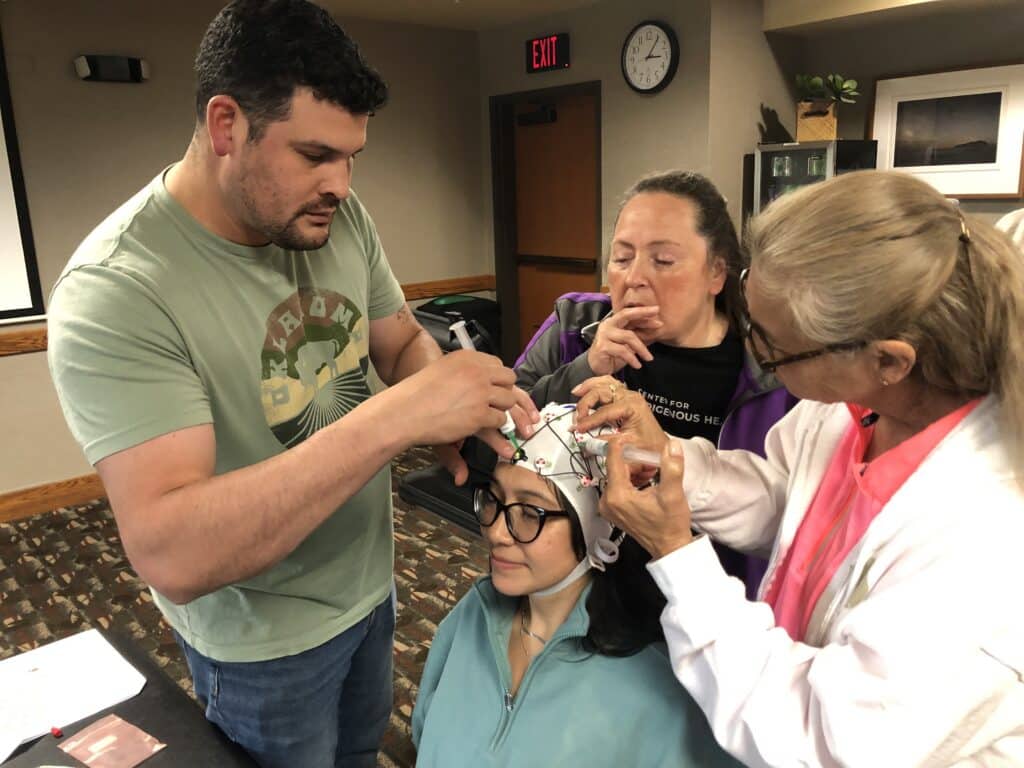
With Miigis as the Principal Investigator, Gii’igoshimong: Sitting With Your First Family is an innovative randomized controlled trial using EEG tests (a noninvasive way to measure brain activity) and questionnaires to measure participant health and wellbeing before and after taking part in ceremony. The approach, to leverage cultural strengths-based solutions to improve Indigenous community health, is a signature of CIH programs.
But for Miigis, the work is deeply personal long before it is scientific.
“This is a long story when I get into it,” she said with a laugh during a recent interview. “It always starts with my niece.”
Miigis grew up in a family deeply committed to Ojibwe language and cultural revitalization. Over time, she said, each generation in her family has gained greater access to language immersion, ceremony, and cultural teachings even as, like many Indigenous families, ceremonies and teachings were disrupted by generations of colonization.
The power of one ceremony in particular — Gii’igoshimong, which is traditionally offered to young people during their transition from childhood to adulthood — stood out to her.
Miigis and her sister did not participate in the ceremony, as was true for many in their generation. By the time her niece reached puberty, they felt unprepared – realizing they had to source knowledge held throughout their family and apply their own skills. “I sew and bead, so I started working on a really nice flower appliqué bag for my niece’s women’s supplies. In our culture, young women are considered to be so powerful [during the first year of menstruation] that they also use their own dishes. So I also made a bag for her bowl, plate and spoons.”
As she sewed, she kept thinking about the other young women in her community.
“I remember feeling like, ‘I wish I could do this for every single one of these young girls’ because I have so much love for them,” she recalled. “The transition to being a woman, no matter what culture you come from, is such a big change in our bodies and in our spirits that it can feel very scary, even shameful. I want our young people to feel the power that they carry and just be so proud of themselves.”
Years later, that feeling became the seed for the Gii’igoshimong study.
A Broader Understanding of Family
The study’s name comes from the Ojibwe term for the ceremony itself. But the subtitle — Sitting With Your First Family — emerged from conversations Gonzalez held with elders and ceremonial leaders while designing the project.
One ceremonial leader described this ceremony as an opportunity to reconnect with a deeper form of kinship.
“For me, and I hope for others, what really grounds us is knowing there is this vast support system beyond our human relatives. Being outside and building that greater connection to the earth, to all the helpers out there, is so powerful.”
“She said sometimes this is people’s first opportunity to sit with their first family,” Gonzalez explained. “She said, our first family isn’t our parents or even our ancestors. It’s the spiritual helpers that are available at all times when we go out into the woods.”
For Gonzalez, that teaching is foundational to the entire project.
Ceremony as an Indigenous Health System
Through 2028, the Gii’igoshimong study will invite Indigenous adults from communities across the Great Lakes region to prepare for and participate in the life course ceremony. Elders and cultural leaders, who Miigis designed the study with, emphasized that Gii’igoshimong is beneficial even at later stages of life, and can be relied on at various times in our lives.
The research team includes Dr. Evan White (Shawnee), a neuroscientist who is leading the use of EEG assessments to understand neurological indicators of health. They will combine EEGs with surveys to measure changes in wellbeing and health indicators before and after participation in ceremony, including substance use, mental health, social support, spiritual connectedness, and sense of purpose.
“We already know there are neurological indicators connected to substance use,” Gonzalez said. “What we’re looking at is: do we see changes in those indicators when people participate in ceremony?”
“My hope,” Gonzalez said, “is that when we can share these results back out to community, it’s helpful and useful for other Indigenous groups across the globe to be able to say, ‘Hey, this is actually the way in which we create wellness and wellbeing in our communities.”
The ceremonies remain private, in keeping with cultural protocols. But Gonzalez emphasized that participants are cared for by a network of ceremonial leaders, family and community members who support both their spiritual and physical needs with everything from staying present to bringing food and caring for the space.
“They are being led by folks who learned from their elders, who learned from their elders. Part of their life’s work is to learn these ceremonies so that we can bring them forward,” she said. “An important part of this project is supporting folks that are working so hard to maintain the ceremonies and teach other community members in turn.”
The work also reflects a broader goal: reclaiming ceremony as a legitimate and evidence-based Indigenous health system.
“We All Have a Purpose”
Throughout the interview, Gonzalez returned repeatedly to one theme: purpose. She describes ceremony as an experience that can help people feel grounded in who they are and why they are here on earth.
“Our elders always teach us that we’re all here for a reason,” she said. “Seeking that purpose and reaching toward it is such an important piece of our wellbeing. This ceremony is really tied to that understanding.”
Recognizing one’s purpose, she believes, extends beyond individual healing.
“All of our gifts are different,” she said. “That’s how we become a functioning community —we need all different types of people doing different types of work.”
For Gonzalez, the vision behind Gii’igoshimong is ultimately about helping Indigenous communities strengthen what has always sustained them: culture, language, ceremony, relationships, and collective care.
+ + +