The Family Spirit program, developed by the Center for Indigenous Health nearly 27 years ago, now has over 190 community-based affiliates across the United States. Through this locally-run model, affiliate programs receive training, curriculum, and ongoing programmatic support, while remaining rooted in the unique strengths and needs of their own communities.
In Oakland, California, Angelina Swayne (Hawaiian, Navajo) is now Program Manager for Native American Health Center’s home visiting program (Strong Families). Her journey from participant to program leader speaks to the transformative power of home visitor relationships far beyond the family unit.
Home visitors trained in the Family Spirit approach meet with mothers beginning in pregnancy and continue to offer tailored supports into early childhood. Angelina’s connection with Shamika Dokes-Brown––the home visitor and mentor who stayed by her side through difficult challenges as well as career leaps––is a reminder of what we are capable of when someone believes in our potential.
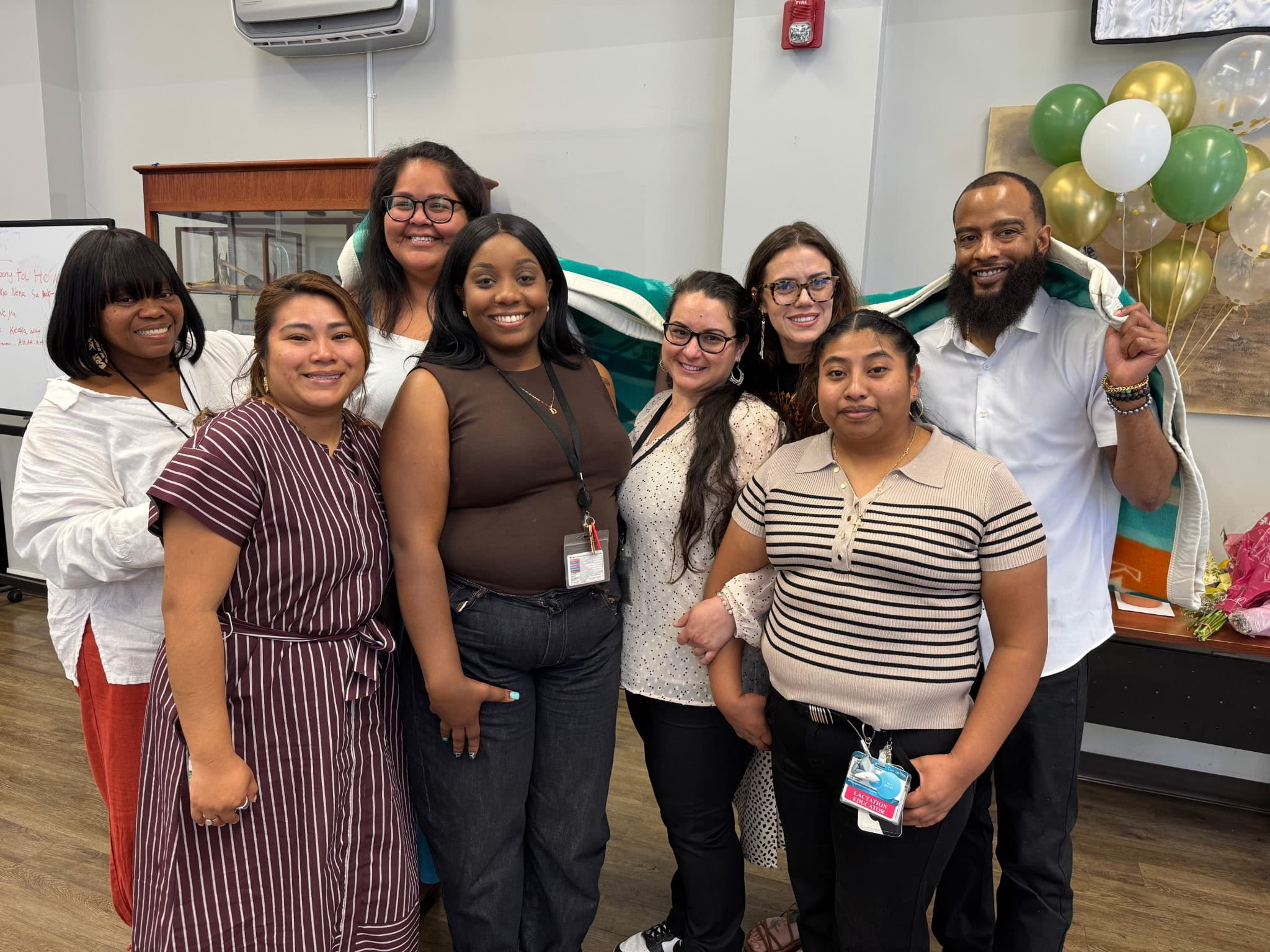
Angelina, center, with her home visiting colleagues at Native American Health Center in Oakland, CA.
Her mentor and former home visitor, Shamika, is on the far left.
“I never had anyone who I could fully rely on—until I met my home visitor.”
Angelina was 21 and pregnant with her first son when she was referred to the Strong Families program in 2013.
“I came into the program from a referral at a local hospital,” she recalls. “I was very early on, maybe three or four months pregnant.”
That’s when she met Shamika, the home visitor who would become a steady and transformative presence in her life.
“We would meet weekly. She’d come to my house, we’d do lessons—but it was so much more than that. If I needed help advocating for myself, she would guide me—help me find the right words —because I never had that modeled.”
Angelina describes a childhood shaped by instability—frequent moves, family struggles with addiction, and exposure to domestic violence.
“Growing up, I missed having a healthy person consistently in my life,” she says. “I always had to be the adult.”
Even as she became a parent herself, she was navigating generational patterns.
“I found myself in a domestic violence situation, but I wasn’t ready to face it. I hid it very well.”
Through it all, Shamika showed up.
“I never had anyone who I could fully rely on,” Angelina says. “My own mother tried her best as a single mom—but the first time I truly knew what that meant was when I met Shamika.”
Showing up for the hardest moments
When Angelina’s son was born with bilateral club feet, it was Shamika who immediately helped her find the right specialist—drawing from her own lived experience.
And when crisis struck, she was there too. In 2019, after years of instability and court challenges, the father of Angelina’s child passed away suddenly.
“That same morning, I got a call from Shamika,” she recalls. “She said, ‘I just wanted to check in—can I come by?’”
Angelina told her what had happened.
“She said, ‘I’m on my way.’ And sure enough, there she was.”
In that moment, and many others, Angelina developed a deep trust in Shamika that fortified her ability to persevere.
“She was the definition of what a home visitor should be,” she says. “Not just teaching—but holding your hand and walking through life with you, even the hard stuff. She helped me to see the future at times when it felt impossible.”
After her son turned five, Angelina graduated from the Strong Families program, but Shamika stayed close. While Angelina initiated therapy to process and heal from past trauma, Shamika helped by coordinating childcare so she could attend sessions.
“She made me believe I was capable.”
As her emotional strength and capacity grew, so did her opportunities.
“In 2019, Shamika told me, ‘You’re capable and intelligent. I want you to try out being a home visitor. Are you ready?’”
The idea felt like a major leap to Angelina, who had spent her career in food service.
“I had never believed in myself like that before,” she says. “But she did and I trusted her. She never steered me wrong.”
Angelina took the job, and a career path unfolded ahead of her.
“It was the best decision I’ve made” she confirmed.
The early months as a home visitor were challenging—especially as she navigated personal triggers while supporting families facing familiar struggles.
“But I had a supervisor who understood. She always saw me. If I needed a moment, it was okay. I wasn’t made to feel ‘less than’ for having emotions.”
The pandemic presented both new professional constraints as well as the birth of Angelina’s second child.
“I didn’t realize it at the time, but I was being challenged to see if I was leadership material.”
Since 2022, Angelina has had three promotions. Today, she leads the Strong Families program.
“At some point, I realized I wasn’t walking behind Shamika anymore,” she says. “I was walking right next to her.”
Leading with heart and nonjudgement
Angelina’s approach to home visiting is deeply shaped by her own experience.
“We do heart work—not just head work,” she explains. “Doing the lessons isn’t enough.”
Instead, she emphasizes presence, timing, and trust.
“It’s knowing when to teach—and when to just listen. We need to recognize when someone needs support versus when they’re ready to learn.”
That philosophy extends across her team, which has grown to five home visitors.
“We love babies, we love getting to know the moms—but it’s by being there for those real moments, the hard and the good, that we can build trust and make an impact.”
Over time, relationships between home visitors and families become mutual, strengthening the fabric of the East Oakland neighborhood where NAHC is located.
“I have families who still check in on me years after they graduate—they ask how I’m doing, how my kids are. We keep in touch and look out for one another.”
Serving Urban Native families in Oakland
Today, NAHC serves a diverse population of Urban Native families, some of whom can trace their heritage as Ohlone People to thousands of years before the city of Oakland existed.
“We have a huge mix—different tribes, different beliefs, different levels of connection to Native culture and spirituality,” she says.
The systemic barriers such as housing instability, food insecurity, and limited access to childcare and education, remain constant.
“Our families work so hard to balance everything—work, school, parenting—plus the curveballs life throws. Home visitors arrive with so much more than curriculum and incentives,” Angelina explains. “We meet people where they are—as parents, as individuals who each face different circumstances.”
Stepping into her new role as Program Manager for Strong Families at NAHC, Angelina is aware of the legacy her mentor imparted.
“I’m not Shamika,” she says. “Her heart, her mind—they’re one of a kind. But her approach to the team and the relationships – it’s with me every day. She taught me how to be softer, think outside the box and truly show up.”
Through home visiting, Angelina is leading the way for others.
“I show my families what it means to have someone in your corner who believes in you and shows up without judgment. It changed my life.”