
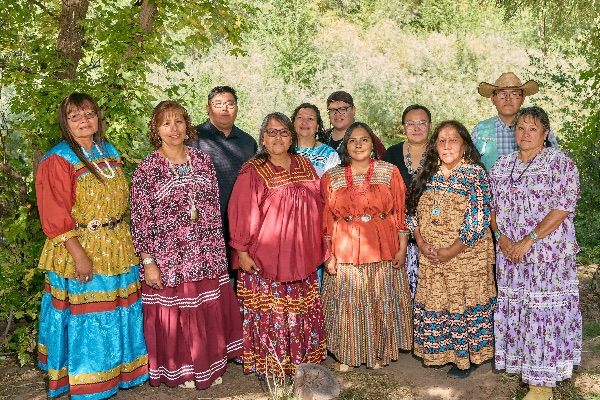
For 19 years and counting, Dr. Novalene Alsenay Goklish has led and nurtured JHCIH’s Celebrating Life program, focused on suicide prevention in the White Mountain Apache Tribe of Arizona. The profound community impact of this work – 38% decrease in suicide deaths and 53% decrease in suicide attempts during the first 12 years of implementation – cannot be overstated. In addition, a newly completed study in the past five years replicated and exceeded these benefits for the study participants.
However, Novalene has an important perspective, “I would like to clarify—it’s not Celebrating Life as a program that is successful. I’d say we succeed on a daily basis because of the staff’s hard work and determination to find those in need and make time to be with them. That could mean being there in the middle of the night or weekends. The losses in our community are still too great, and sometimes we feel like we’ve failed. There are times when we struggle, when we break down and have to sit and pray together. Through prayers and the strengths each of us brings, we always find the resilience to continue to do this work.”
Novalene, a member of the White Mountain Apache Tribe, began her work with CIH in 1997 and has since paved a path of both academic and public health excellence in service of her community. “I just keep saying yes to new opportunities that could help our community”, Novalene explained, “I’ve had exceptional support from my husband, my late mom, my late grandparents and my three children. They believe in me and in the value of education, so I’ve learned to believe in myself through many personal and professional challenges.” In addition to a Bachelor of Science from University of Phoenix, Novalene earned a Masters in Professional Counseling from Grand Canyon University and a Doctorate in Behavioral Health and Management from Arizona State University.
Origins of Celebrating Life
Celebrating Life is rooted in a community call to action. In 2001, after two consecutive years of devastating suicide losses, families came together to address the White Mountain Apache Tribal Council. “Each family had a person who shared their grief with the Tribal Council members. They came to demand that the Tribe do more to stop the community from losing additional members to suicide,” Novalene recalled. The following year, the WMAT passed a tribal law mandating that any suicide-related behaviors be reported to a central suicide prevention registry. The Indian Health Service also developed initial outreach and referral systems in collaboration with Johns Hopkins. The entire program was named, “Celebrating Life.”
Johns Hopkins Center for Indigenous Health, which has a partnership to promote health with the White Mountain Apache community dating back to the 1980’s, was then invited to take over Celebrating Life. “All of the data stayed exclusively with the Tribe, but they trusted me to go through and summarize it for our NARCH grant application,” Novalene said. “After I played that key role in securing initial funding, the Center’s leaders invited me to coordinate the program. I talked to my family members first and they all had the same response in different words – reminding me that I’m strong and capable of anything. I’m always up for a challenge, and that was 19 years ago this fall.”
When Novalene assumed the leadership role for Celebrating Life in 2006, she focused on suicide prevention by growing a local case management team. “Our colleagues in Baltimore, who included licensed psychiatrists, psychologists and social workers, all helped develop our initial training for our outreach team. Since then, we do all our training at the local level—providing a broad array of training to prepare our staff. Today I have a team of six community mental health specialists, all of whom are White Mountain Apache. We receive referrals about suicidal individuals from across the reservation and do our best to find each person and connect them to care. Each day is different – we may leave for work thinking we’ll focus on one thing and once we arrive to the office, we are prepared to adapt our schedules to whatever are the current needs of the community. We have to remain as flexible and understanding when we come to work.”
Achievement and Hope
Celebrating Life has earned national recognition for reducing suicide on the White Mountain Apache reservation as well as awards from the American Psychiatric Association, the Substance Abuse and Mental Health Services Administration, and the Indian Health Service. The Celebrating Life surveillance system has served as a model for the San Carlos Apache Tribe, the Hualapai Tribe, Cherokee Nation of Oklahoma, areas of Navajo Nation and Colville Confederated Tribes, and the Lummi Nation. The program is currently being packaged for implementation in other tribal communities with support from the Bloomberg American Health Initiative.
Novalene confirmed. “I have come to understand our own people are capable of saving our own community members. I’ve seen it and that’s why I love what I do. Knowing that we are able to help even one person in their darkest hour of need keeps me coming back time and time again.”
To partner with the Celebrating Life Team, contact Kathleen Grealish at kgreali1@jhu.edu.