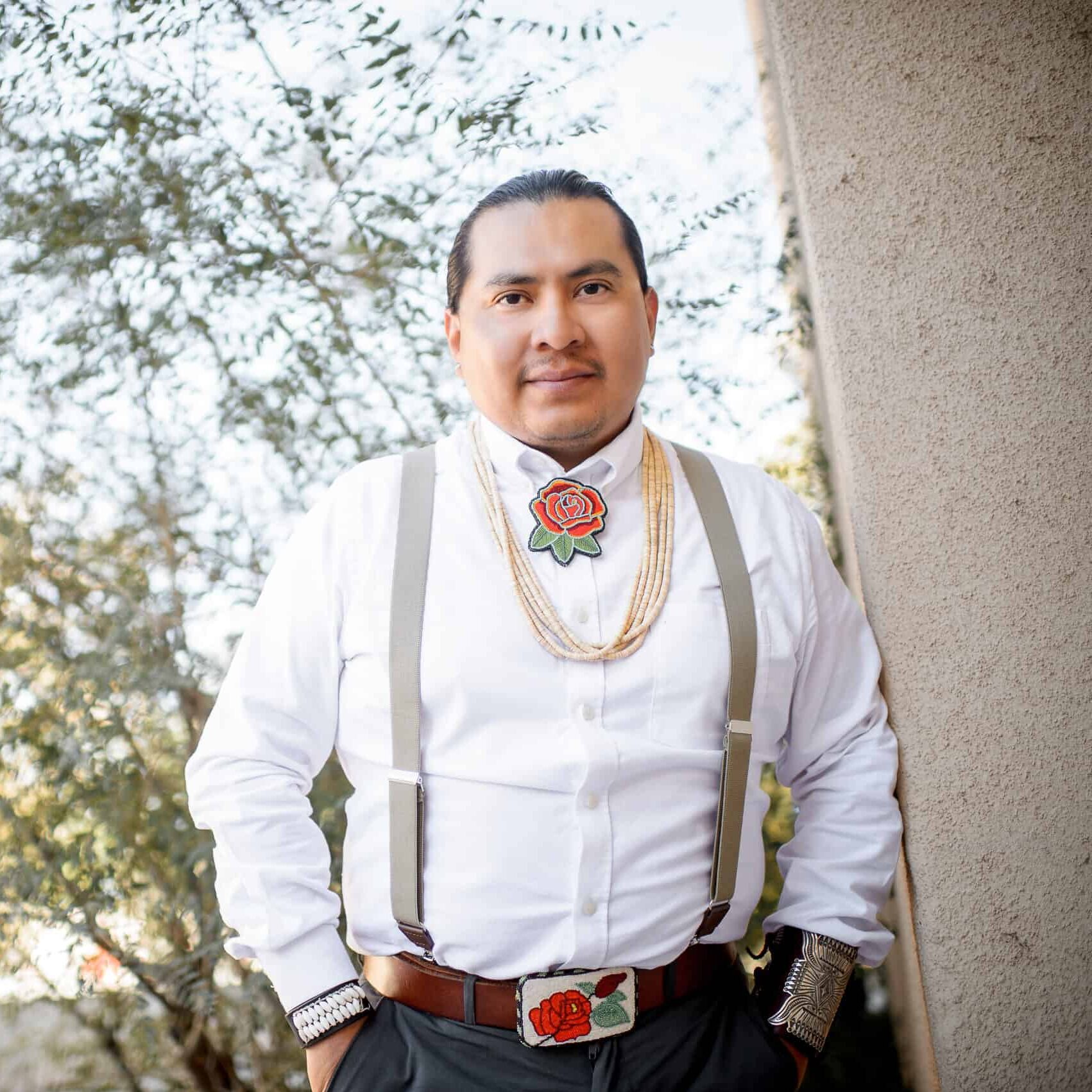
What began as persistent questions on the prevalence of language delays in Native American children has grown into +Language is Medicine (+LiM), a groundbreaking initiative awarded more than $3 million from the National Institutes of Health in September 2025. Led by Principal Investigator Joshuaa Allison-Burbank (Diné and Acoma Pueblo), the award demonstrates what is possible when promising, community-grounded ideas receive philanthropic support at their earliest stages.
The +LiM pilot study launched in 2023 after being selected for early investment through the Center for Indigenous Health’s Willow Fund, with additional funding from a generous family fund. For Joshuaa, the work emerged from trends he observed while training as a speech language pathologist (SLP). “I had burning questions – why aren’t Native children talking? Why are developmental delays so common? Where should we intervene to support the full scope of a young child’s development?” he said. “I had to become a clinician-scientist to investigate how early language development in a Native cultural context supports motor skills, cognition, social emotional learning, and problem-solving.”
Joshuaa and team know that preventing early developmental delays will improve health, education and social outcomes across the lifespan. “As Language is Medicine grows, we’re situating it within well-established tribal home visiting programs, including CIH’s 30-year-old Family Spirit program. Home visitors are best positioned to screen for kids at risk and coach caregivers to implement the +LiM strategies that strengthen a child’s holistic development.”
Designing a Culturally Grounded Language Intervention
While earning his PhD in speech-language pathology at University of Kansas, Joshuaa gained a public health lens by taking the CIH certificate program in American Indian Health. Upon graduation, he returned home to Navajo Nation – where he was born and raised – to practice as the only SLP at the Indian Health Services (IHS) location in Shiprock, New Mexico.
“Saad éí azee’ (Language is Medicine) started as a small group discussion with local farmers and myself,” he recalled. “We asked ‘where do Shiprock children learn best?’ It’s in the ditches, counting corn, at the fair, ceremonies, gathering wood. It’s in cultural activities full of laughter, storytelling and a lot of back-and-forth interaction.”
With a Community Advisory Board to guide them, the +LiM team built a program of language interventions around cultural and seasonal routines alongside developmental assessments. While mapping routines is common in speech therapy, Joshuaa notes that Western approaches alone miss the richness of Diné language and the lived experience of Navajo families.
Promising Pilot Study
The +LiM pilot study was designed for parents and caregivers of toddlers in the Shiprock area and delivered in five lessons by a community-based Diné Family Health Coach. Lessons emphasize responsive communication in daily routines, following the child’s lead, book reading, pretend play, and incorporating Diné language into everyday life.
“Families that have experienced significant trauma – especially when household members attended boarding school – often fall back on authoritarian language with young children,” Joshuaa explained. “We help caregivers shift from behavior management to language rich communication.”
Through the program, caregivers learn to label emotions, wait for a child’s response and model language. “It’s like we turn on these warm heart feelings that build pride in parenting. Often we’re touching on a soul wound that a caregiver has from childhood, and filling it with love and warmth. Researchers might call it building ‘parental self-efficacy’, I think of it as a lightening up of the soul – we see it with almost every family.”
A Major Milestone: NIH Invests in Language Is Medicine
On the team’s third submission to the NIH’s National Institute on Minority Health and Health Disparities, +LiM received welcome news: not only was the R01 grant funded, it was funded above the original request. With $3.1 million allocated over four years, the project will expand to high-needs regions of Navajo Nation (adding Fort Defiance and Eastern Agency, near Joshuaa and team’s Albuquerque base) and deepen its research goals.
The Randomized Control Trial will test the effectiveness of +LiM on child development, examine caregiver behavior beyond home visits and use implementation science to understand how the model can be adopted and sustained. “We have strong partnerships with the Navajo Nation’s early intervention program, Growing in Beauty, and tribal home visiting programs,” Joshuaa said. “Our goal is to make sure no Navajo kid falls through the cracks.”
Looking ahead, Joshuaa and team have a bold vision. “Long-term, we want any Native parent with concerns about their child’s development to have access to a quality program like Language is Medicine – here, and eventually across other tribal communities as well.”
Interested in learning more about +Language is Medicine? Send inquiries to Kathleen Grealish at kgreali1@jhu.edu.