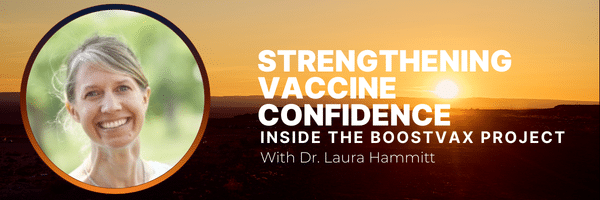
An interview with Dr. Laura Hammitt, CIH Director of Infectious Disease Prevention
Can you introduce yourself and your role in the BoostVax project?
Dr. Hammitt: I’m Laura Hammitt, a pediatrician and epidemiologist by training. I lead our Infectious Disease Prevention Team and have the honor of co-leading the BoostVax project, which is a collaboration with the Indian Health Service, with Dr. Chelsea Kettering (Navajo).
What are the goals of BoostVax, and where is the project active?
Dr. Hammitt: Ensuring high levels of immunization protection is critical, especially given the historical and present-day disparities in infectious disease affecting Indigenous communities.
Through the BoostVax project, we’re bringing vaccinators from different communities together in a community of practice—sharing resources, troubleshooting challenges, and learning from one another.
We’re also working directly with teams in the Whiteriver, Pine Ridge, and Blackfeet service units to co-design training materials that support health care providers in answering common vaccine questions and delivering strong vaccine recommendations.
One of the most meaningful parts of this work has been listening to providers who have spent decades working in Tribal communities. They provided care during periods of time before we had all the vaccines that are recommended now, and they have firsthand experience seeing hospital wards full of children with severe dehydration from rotavirus and caring for infants suffering from serious infections like Haemophilus influenzae type B meningitis.
For them, the possibility of these diseases making a comeback is deeply concerning. They want the right tools and language to answer questions and protect their communities.
What trends are you seeing in vaccine coverage right now?
Dr. Hammitt: Vaccine coverage really declined during the pandemic, largely because clinics were very focused on caring for people who were really sick with COVID. People were largely asked to stay at home unless they needed to come, so they delayed routine care.
Coverage started to rebound as families returned to well-child and preventive care visits, but recent changes in the federal landscape – including changes to the federal immunization schedule and advisory committees – have caused confusion and sown uncertainty.
We’re now starting to see declines in immunization, both nationally and in Indigenous communities, which is concerning because that leaves people vulnerable to infection.
It’s in fact because of vaccination that many diseases that once caused severe illness, long-term disability, and even death in children have now become rare. But, as vaccination levels drop, these diseases can return quickly, as we’re already seeing with the measles outbreaks that are ongoing in many parts of the country where the vaccine coverage actually fell below that critical level that’s needed to sustain community immunity.
The BoostVax project is working to reverse these concerning trends by equipping providers to be able to confidently communicate about vaccines and to answer questions that families may have about the best ways to protect their loved ones.
What does “vaccine confidence” mean in practice?
Dr. Hammitt: Vaccine confidence really comes down to trust – trust in the vaccines themselves, in the healthcare professionals administering them, and in the systems that guide the development, licensure, and safety monitoring.
Right now, misinformation is really eroding vaccine confidence.
Several of the pediatricians that we’ve talked to recently as part of the BoostVax project have reported an uptick in refusal of routine newborn interventions like the hepatitis B vaccine and vitamin K shots. These are very safe and important interventions that prevent catastrophic disease in babies. The fact that these concerns are emerging is alarming and seems to be driven largely by outside misinformation.
Despite these challenges, are you seeing any bright spots?
Dr. Hammitt: Yes – there are a lot of bright spots. Community members really continue to be very focused on collective responsibility for the protection of infants and elders and other people who may be at high risk, such as people who have chronic underlying disease or who may have weakened immune systems.
We’ve heard from traditional practitioners who’ve highlighted the imbalances that come from modern day life that have led to infectious disease risks and see these vaccines as important new tools for training our warrior cells to fight off disease.
We’ve heard from grandmothers and great grandmothers who remember the suffering and loss caused by some of these diseases and, based on their own personal lived experience, are incredibly passionate about ensuring their loved ones are protected by vaccines.
We’ve also heard from young adults, many of whom may live with their elders and want to do everything possible to ensure their health and well-being as the family’s wisdom keepers.
What advice do you have for people having conversations about vaccines?
Dr. Hammitt: First, it’s important to remember that Indigenous children should continue to be offered protection with all available childhood vaccines. Staying on schedule with the vaccines that fall into the routine, the high risk, and the shared clinical decision-making categories ensures that children are protected as early as possible when they need that protection the most.
When children are vaccinated, it not only protects the child but also helps prevent the spread of disease. In this way childhood immunizations can also help prevent disease in elders, relatives, other people in the community who could get very sick from infections.
Second, it’s important for people to know that it’s natural to have questions. We all want to be confident that we’re making the best choices for ourselves and for our family members.
We need to respond to questions with reliable and accurate information, but also with empathy. We’re all on the same team, and we all want to keep families healthy and thriving. I often find that it can be helpful to even talk about my personal choices that I’ve made for myself and my family. Every pediatrician I know who has kids vaccinates them on the recommended schedule, because we are so confident in their safety and ability to prevent serious disease.
Finally, it’s important to rely on trusted sources of information. There is a lot of incorrect and misleading information out there, and it can be pretty convincing and very hard to sort through. My advice to families would be to avoid social media entirely for information about vaccines and to seek reliable sources, such as their pediatrician or professional organizations like the American Academy of Pediatrics.
Is there anything else people should understand about this moment?
Dr. Hammitt: It can be confusing because the politics have changed but families should know that the science has not and that vaccines are as important as ever.
Vaccines teach our immune system to safely make antibodies that can protect against serious diseases. It’s much safer for our immune systems to learn this through vaccination than by catching a disease and having to suffer through an illness and the potential long-term effects of an illness. It’s much safer for the immune system to develop this protection through vaccination.
Life can get busy and I don’t always get my daughter into the clinic exactly on time for her vaccines but I do make sure that she stays up-to-date because, as a mom, that is how I can help protect her and keep her healthy.