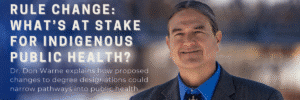
Across the country, proposed federal policy changes, which would exclude public health degrees (MPH and DrPH) and nursing from a new definition of professional degree programs, could have far-reaching effects on public health education and the future workforce serving Tribal and rural communities. As the proposed changes remain open for public comment until March 2, 2026, we invited our Co-Director, Dr. Donald Warne, to share his perspective.
Donald Warne (Oglala Lakota), MD, MPH is an acclaimed physician and one of the world’s preeminent scholars in Indigenous health, health education, policy and equity. A member of the Oglala Lakota tribe from Pine Ridge, South Dakota, he leads the Johns Hopkins Center for Indigenous Health’s Great Plains Hub in Rapid City, SD as well as the development of the nation’s first Indigenous-focused Doctor of Public Health (DrPH) and a corresponding Indigenous concentration in the Master of Public Health (MPH).
In this interview, he explains how proposed federal changes to degree designations could narrow pathways into public health and deepen existing workforce shortages.
Q: From your perspective as both a community-based and national public health leader, what’s at stake if public health degrees are no longer recognized as professional programs?
Dr. Warne: First, it’s disrespectful to the field of public health. When we look at improvements in life expectancy over the last century, the vast majority are due to public health advances — not medical care. This change profoundly fails to acknowledge the profession’s impact and contributions.
It also affects eligibility for scholarships and financial support. We need more public health professionals, not fewer. Redefining these degrees as non-professional could limit students’ ability to pursue public health at a time when workforce expansion is critical.
Q: How could these proposed changes affect the pipeline of Indigenous students entering public health, and what would that mean for Tribal and rural health systems?
Dr. Warne: Many Indigenous students and future public health professionals come from low-resource backgrounds and depend on scholarships to pursue higher education. These changes would likely reduce the number of Indigenous students entering the field.
Long term, that means less diversity in the profession. We know that cultural concordance between health professionals and the populations they serve improves quality of care. Without that, we risk lower-quality services and worsening health disparities.
Q: You helped develop the first Indigenous DrPH and MPH programs. How do financial aid policies shape who can pursue this training?
Dr. Warne: Some scholarship programs are specifically tied to health professions. If public health degrees lose that designation, we could see reduced access to financial resources to cover tuition. That would negatively affect enrollment and, ultimately, workforce development.
Q: You’ve spoken about your mother’s work as a community nurse. How did her example influence your path, and how might these changes affect future professionals from similar backgrounds?
Dr. Warne: Watching my mother’s meaningful work as a public health nurse helped me understand how essential this profession is to community wellbeing.
I saw my mom dedicate her talent and love and care to the health of my community over decades, and she made a difference. We need pathways for the next generation to make a career out of nursing or public health. If we can’t get those mission-driven people into the field to begin with, because tuition is unaffordable, our workforce will be unsustainable. The financial aid and scholarship pathways are critical.
Q: What difference does it make when public health professionals are from — or trained within — the communities they serve?
Dr. Warne: When there is cultural concordance between practitioners and the populations they serve, we see better communication, stronger cultural competence, and higher-quality services. Diversity in the public health workforce is essential to delivering effective care.
Q: What message would you share with federal policymakers about this rule change and Indigenous public health?
Dr. Warne: This change could reduce the number of Indigenous people entering public health. I would simply ask: what is the justification? I have not seen a meaningful explanation that demonstrates any benefit from making this change.
Related Resources:
- Steps to submit an effective comment (deadline is March 2, 2026).
- The Association of Schools and Programs of Public Health (ASPPH) is leading national advocacy to ensure that public health degrees remain recognized and supported as professional under the Department of Education’s One Big Beautiful Bill Act (OBBBA) proposal. These FAQs outline the proposal, its impact on student aid, and key advocacy timelines.