
Skip to the content

Governance

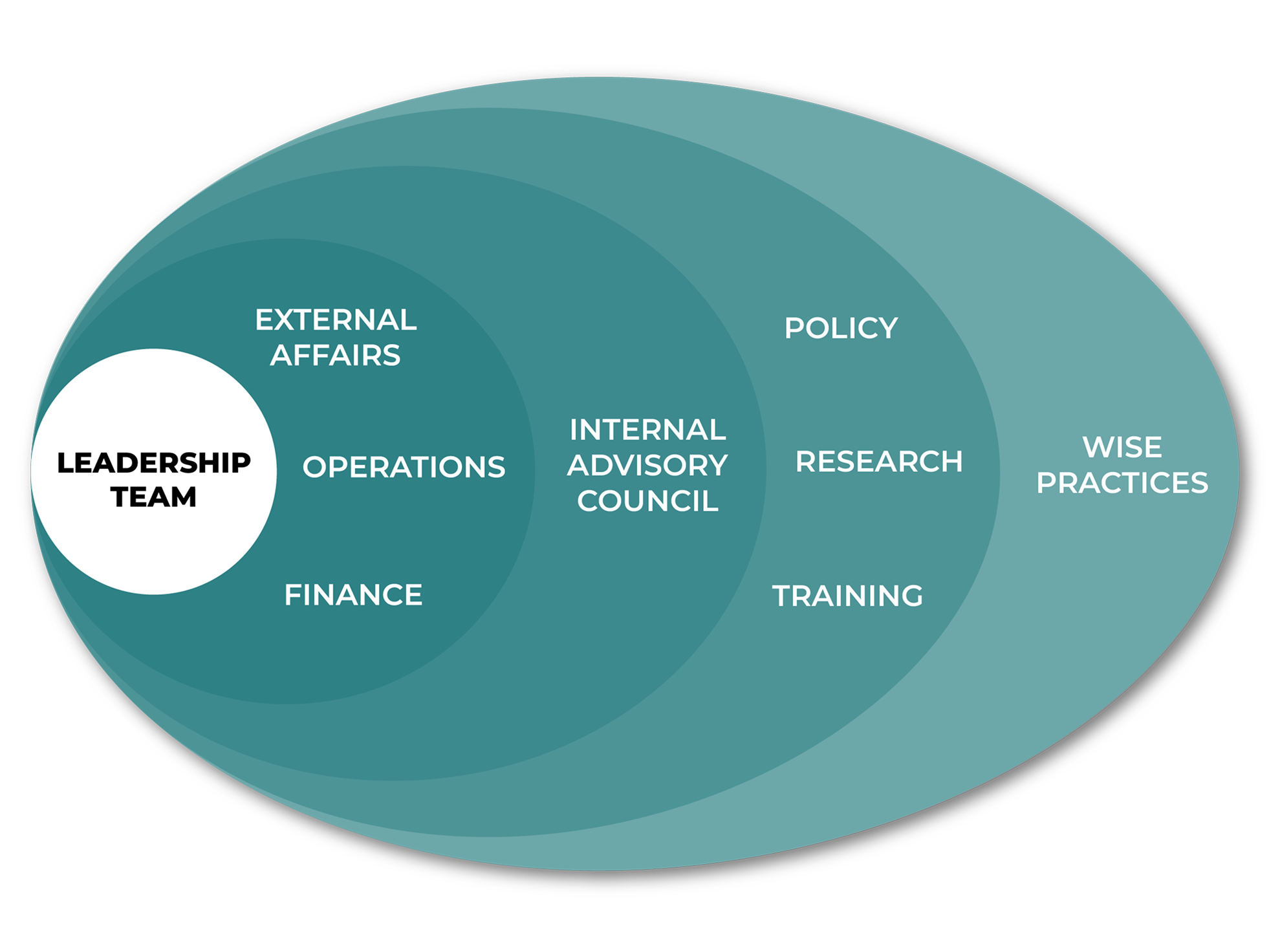
Venn diagram with overlapping ovals displaying "Leadership Team," "Operations," "Internal Advisory Council," and related topics like "Policy" and "Training."

Governance Structure

The Center is evolving to a shared governance structure that provides opportunity for diverse voices of the tribal communities we work with to inform Center decision making. For this purpose, the Center governance structure includes the Center for Indigenous Health Advisory Council.

Venn diagram with overlapping ovals displaying "Leadership Team," "Operations," "Internal Advisory Council," and related topics like "Policy" and "Training."

CIH Internal Advisory Council

The Internal Advisory Council is comprised of CIH staff who undergo a nomination and election process in each community site. Members from the Internal Advisory Council bring forth input to CIH leadership from the sites they represent. The three co-chairs of the Internal Advisory Council will represent diverse tribal regions where we have community-based worksites, and meet with the Center’s Leadership on a regular basis.

Relationship to Johns Hopkins University

The Center for Indigenous Health was founded in 1991 and based at Johns Hopkins Bloomberg School of Public Health, the largest and #1 ranked school of public health in the world.


Today, the Center’s programs reach more than 165 tribal communities across the country. The Center has administrative offices in Baltimore, MD, Albuquerque, NM, and Pinetop, AZ; a Great Lakes regional hub in Duluth, MN serving 11 Ojibwe Tribes; and eight satellite offices in reservation communities in AZ and NM working in close partnership with the White Mountain Apache Tribe and Navajo Nation.


While based at Johns Hopkins, the Center for Indigenous Health is financially independent and depends on philanthropic contributions to support our work.

Privacy Overview

This website uses cookies so that we can provide you with the best user experience possible. Cookie information is stored in your browser and performs functions such as recognising you when you return to our website and helping our team to understand which sections of the website you find most interesting and useful.