About
Background and Purpose
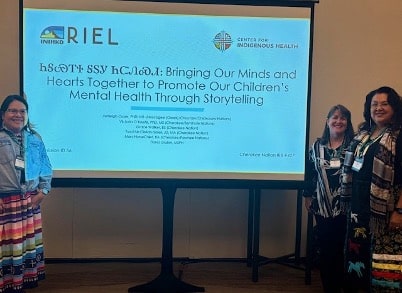
ᏂᎦᏯᎢᏐ ᎦᏚᎩ ᏂᏨᏁᏍᏗ means “in the mind and heart always have the thought of working together” (credited to Cherokee cultural keeper, Benny Smith, 1938-2018). This Cherokee community value is at the core of this project which brings together Johns Hopkins Center for Indigenous Health, Cherokee Nation Behavioral Health, and Cherokee Elders, cultural keepers, community members, and mental health providers to develop a children’s storybook to promote mental health. Storytelling is an important cultural tradition and a powerful Indigenous public health approach that promotes individual, family, and collective well-being. For Cherokee people, stories represent the first expression of cultural knowledge and understandings that are transmitted across generations. Developing a children’s storybook rooted in Cherokee worldviews and values will promote cultural strengths and mental health, and support children and families throughout Cherokee Nation.
This storybook intervention builds on CIH’s successful Our Smallest Warriors, Our Strongest Medicine book series co-led by Dr. Victoria O’Keefe (Cherokee Nation/Seminole Nation) and Dr. Emily Haroz alongside a national advisory board and cultural keepers. This series was showed widespread popularity and was shared with more than 92,000 children and families from over 150 Tribes, across 29 states, and 12 First Nations in Canada. Surveys revealed that caregivers were interested in future storybooks that specifically prioritized mental health.
Our collective team is grateful to build upon prior work while coming together to develop a storybook intervention for Cherokee children and families.
Indigenous CBPR Approach
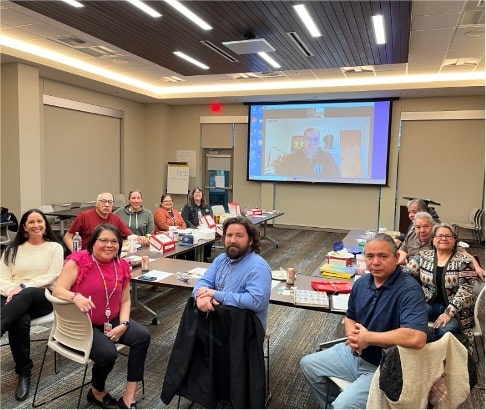
Our project uses an Indigenous CBPR approach which promotes collaborative, equitable partnerships in all phases of research, builds on existing community strengths, and honors Tribal sovereignty. To guide the project, we formed a Community Advisory Board with 10 Cherokee Nation Elders, storytellers, authors, illustrators/artists, language speakers and cultural keepers, and mental health and social service providers (see Team below). We also use Storywork, an Indigenous Research Methodology that highlights the value of Indigenous stories, to guide our work. This methodology centers Indigenous stories within educational and research contexts and involves storytellers, story listeners, and community.
Who we are
Community Advisory Board Members
We would like to thank and acknowledge past and present Community Advisory Board members, including:
Abraham Bearpaw (Cherokee Nation)
Woody Hansen (Cherokee Nation)
Joyce Hansen (Cherokee Nation)*
Mary HorseChief, BA (Cherokee/Pawnee Nations)
Teresia Jones, BS (Cherokee Nation)
Harry Oosahwee (Cherokee Nation)
Sarah Oosahwee MS, (Cherokee/Mandan, Hidatsa, Arikara Nation)
Traci Sorell, JD, MA (Cherokee Nation)
Alex Stephenson, MS (Licensed Behavioral Health Provider at Cherokee Nation)
Christopher Teuton, PhD (Cherokee Nation)
Victor Wildcat (Cherokee Nation)
*In memoriam
We dedicate this Storybook Project in honor of Mrs. Joyce Hansen, Cherokee Nation (1961-2025), a devoted member of our CAB who believed in using Cherokee strengths and values to promote children’s health and well-being. Her love for this project continues to inspire our work every day. The wisdom and creativity she contributed to this work will live on in this storybook and the children and families across Cherokee Nation that it aims to support.
Cherokee Nation Behavioral Health
Ashleigh Coser, PhD, MS (Muscogee/Choctaw/Chickasaw Nations), Co-Principal Investigator
Johns Hopkins Center for Indigenous Health Research Team
Victoria O’Keefe, PhD, MS (Cherokee Nation/Seminole Nations), Co-Principal Investigator
Rivka Keshen, MSPH, Project Coordinator
Valentin Sierra, PhD, MSW (Yoeme), Postdoctoral Research Associate
Student Research Team
Grace Walker, BS (Cherokee Nation), Student Research Assistant, Oklahoma State University, Clinical Psychology PhD Program
Learn More
For more information or if you are interested in reading articles that have been written for this project, please review our list of publications:
Contact Information
Please contact Rivka Keshen (rkeshen1@jh.edu) and Dr. Victoria O’Keefe (vokeefe3@jhu.edu) with any additional questions or inquiries.