Helen Russette—JHCIH Assistant Scientist and citizen of the Chippewa-Cree Tribe—believes her homeland of Rocky Boy’s reservation in Montana holds the power to heal and protect her people. “The healing powers are well evidenced in our literature and science, and we know that dosage matters,” she explains. “Teens who participate more often in land-based cultural activities are more protected against depression, anxiety and early alcohol use. Another theme I’ve seen is that the earlier the intervention, the greater impact we can have on a young person’s life.” These insights are the foundation for Returning to the Land (E wahw nik otah Ahskik), the pilot program Helen is leading in partnership with the Chippewa Cree Tribe.
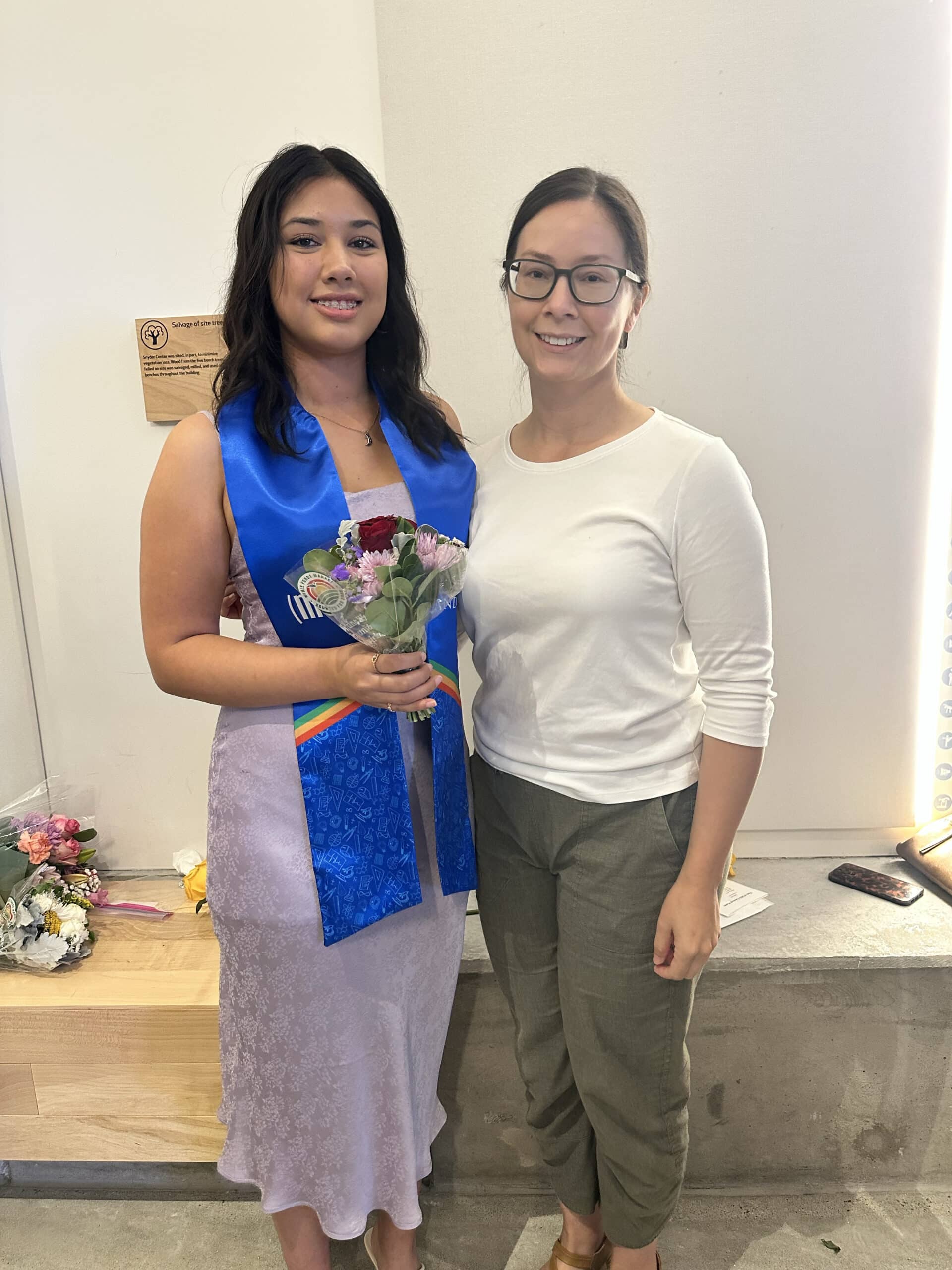
Helen Russette (right) standing next to her daughter (left) at her graduation from the MS(2) program at Phillips Academy.
Helen’s public health journey began at Box Elder High School on the reservation. “During the late 2000’s, I saw a lot of pain and suffering among my friends and family particularly from the opioid epidemic and low employment. It was challenging, but we have a close-knit community with deep strengths.” An internship collecting data on healthy food options opened her eyes to research as a tool for change. “After three years, I saw fruits and vegetables in our grocery store counters. It showed me that research has power—and if done in a good way, it can bring positive changes.”
Helen’s late father always set high expectations for her potential. As a freshman in college, she became a mother—a challenge she met with determination and resilience. She earned a full scholarship to any university, then pursued a PhD in Public Health at the University of Montana. “It was humbling to rely on scholarships, food stamps, and temporary assistance as a single mother. But I have always had a very strong work ethic. With the support of my family, community, and academic mentors, I earned my degrees and built my professional network through the Native Children’s Research Exchange.”
In 2021, Helen joined the Johns Hopkins Center for Indigenous Health as a postdoctoral fellow, drawn by the success of the Family Spirit Home Visiting program for young families—the same population she hoped to serve. She discovered the Indigenous Traditional Ecological Knowledge (ITEK) framework, which now guides her work. “ITEK focuses on the spiritual and cultural connections between our people and Mother Earth. It recognizes that all elements of life are in sacred relationship. My program is led by Elders—who are our holders of language, stories and traditional knowledge—connecting with families in a supportive group setting.”
Returning to the Land will launch a pilot in July 2026 to enroll a cohort of young parents and their children in up to 15 modules led by Traditional Knowledge Holders. Half of the participants will meet at a tribal youth center while the others will gather at sacred and historical locations across Rocky Boy lands. “We want to instill a sense of cultural identity and belonging, whether they live on the reservation or nearby. For those with a history of addiction, instead of shaming them we’re using land-based cultural practices to bring them in closer—to reconnect them with culture, land, Elders, and other families as a way of fostering resilience and to cope with any hardships.
Helen’s ambition goes beyond healing young families to healing the land itself through hazard remediation. Partners at Rocky Boy Health Center are covering the cost of infrastructure required for project implementation, as well as dedicating staff to ensure safety and sustainability at each site. As Helen spreads awareness of this project across Montana, she is working hard to leverage a wide variety of supports. “This work is holistic, and it is truly culturally grounded,” Helen says. “There are unanticipated costs associated with doing this work in the right way. We are grateful that our community believes in land-based healing—and are willing to invest in the promise it holds.”